There is no single standard capacity for a transformer oil tank. Its size depends on the transformer's rated power, voltage class, cooling arrangement, internal clearances, insulation design and required oil volume.
For small distribution transformers, the tank may contain only a few hundred litres of insulating oil. A large power-transformer tank, by contrast, may hold tens of thousands of litres. This is why a tank should never be selected based on transformer kVA or MVA alone.
Transformer Rating and Tank Capacity Are Not the Same
When buyers ask about "transformer tank capacity," they may mean one of three things:
The transformer's electrical rating, expressed in kVA or MVA
The internal volume of the transformer tank
The quantity of insulating oil required, expressed in litres or kilograms
These values are related, but they are not interchangeable.
A 1,000 kVA transformer is an electrical rating; it does not mean that its tank holds 1,000 litres of oil. Two transformers with the same kVA rating may require different tank dimensions because of differences in core-and-coil design, voltage level, insulation distance, tap-changer arrangement or cooling system.
Typical Transformer Oil Tank Capacity by Application
The following figures are broad industry references rather than fixed design rules:
| Transformer category | Typical transformer rating | Indicative oil quantity |
|---|---|---|
| Small oil-immersed distribution transformer | 25–500 kVA | About 100–800 litres |
| Medium distribution transformer | 500–2,500 kVA | About 600–3,000 litres |
| Pad-mounted transformer | 75–5,000 kVA | About 200–5,000 litres |
| Small power transformer | 5–40 MVA | Several thousand to tens of thousands of litres |
| Large power transformer | Above 40 MVA | Often tens of thousands of litres or more |
Actual oil quantity can fall outside these ranges. The final figure must come from the approved transformer design and filling calculation.
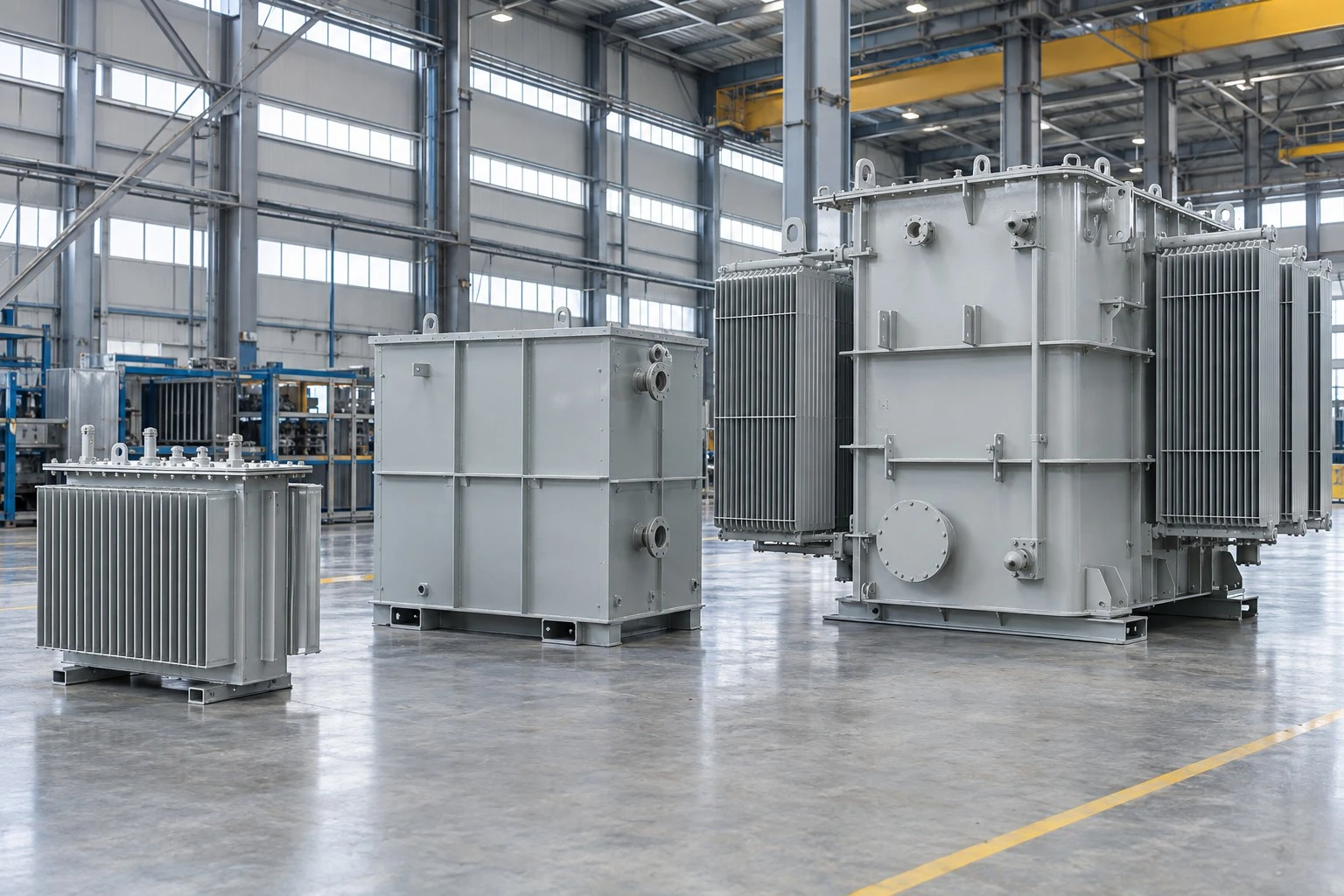
A distribution transformer oil tank is normally compact and may use corrugated fins for both cooling and oil-expansion compensation. A power transformer tank is much larger and commonly works with detachable radiators, a conservator, valves, bushings and other accessories.
These different arrangements directly affect the total oil quantity and tank geometry.
What Determines the Required Tank Size?
1. Core-and-Coil Assembly
The active part determines the minimum internal length, width and height. The design must provide adequate electrical clearances while leaving enough space for assembly, lifting and oil circulation.
2. Voltage Class
Higher-voltage transformers generally require greater insulation distances. Therefore, two units with similar power ratings can use noticeably different tank sizes when their primary voltages are different.
3. Cooling Method
A corrugated transformer oil tank can dissipate heat through its fin walls. Larger transformers may require external radiator banks.
The oil inside the radiators, connecting pipes and headers contributes to the transformer's total oil quantity, even though it is not contained entirely inside the main tank.
4. Oil Expansion Space
Transformer oil expands as its temperature rises.
Sealed distribution tanks need suitable expansion space within the tank or through flexible corrugated walls. Conservator-type transformers handle expansion in a separate vessel, changing the main-tank filling level and overall oil calculation.
5. Fittings and Internal Components
Bushings, tap changers, cable boxes, magnetic shunts, shields, internal supports and inspection openings can all influence the shape and usable internal volume of the transformer tank.
6. Transportation Restrictions
Road limits, container dimensions, lifting capacity and site access may determine whether radiators, conservators or other components must be removed for shipment.
For a large power-transformer project, transportation requirements should be considered before the tank drawing is finalized.
How Is Transformer Oil Volume Calculated?
The basic tank volume can be estimated from its internal dimensions, but a simple length × width × height calculation is not enough for production.
The designer must also account for:
The volume displaced by the core-and-coil assembly
Internal structural parts and accessories
The normal oil filling level
Oil inside radiators, headers and connecting pipes
Thermal expansion allowance
Conservator volume, where applicable
Practical filling and manufacturing tolerances
For this reason, the oil quantity shown on a nameplate or technical data sheet should be treated as a design result-not as the starting point for estimating tank dimensions.
Why Drawings Are Essential When Ordering a Transformer Tank
A reliable manufacturer cannot quote an accurate transformer oil tank from the kVA rating alone.
At minimum, the supplier should review the general arrangement drawing, tank drawing or active-part dimensions, together with the following information:
Transformer rating and voltage ratio
Overall tank dimensions
Required steel material and plate thickness
Cooling arrangement and radiator details
Bushing, valve, flange and accessory positions
Surface-treatment and coating requirements
Leak-testing requirements
Order quantity and delivery schedule
Manufacturing from approved drawings also reduces the risk of flange misalignment, insufficient internal clearance, incorrect oil volume and assembly problems at the customer's factory.
Custom Transformer Oil Tanks from ZHIHE
ZHIHE manufactures custom transformer tanks for distribution transformers, pad-mounted transformers and power transformers based on customer drawings and technical specifications.
Our product range includes:
Corrugated transformer tanks
Cylindrical single-phase transformer tanks
Single-phase and three-phase pad-mounted transformer tanks
Large power-transformer tanks
Production combines robotic welding workstations with skilled manual welding where required. Tank welds are inspected through controlled leak-testing procedures before surface treatment. Coating systems can also be selected according to the required operating environment.
Because every transformer tank is project-specific, the final price and production schedule depend on the approved drawings, materials, coating
system, technical requirements and order quantity.

Frequently Asked Questions
How many litres of oil does a transformer tank hold?
A small distribution transformer may use a few hundred litres, while a large power transformer may require tens of thousands of litres. The exact quantity depends on the complete transformer design.
Can tank dimensions be calculated from the kVA rating?
Not accurately. The kVA rating can support an early estimate, but voltage class, active-part dimensions, insulation clearances, cooling method and accessories must also be considered.
Does a transformer radiator increase the total oil capacity?
Yes. Oil circulates through the radiator panels, headers and connecting pipes, so the cooling system increases the transformer's total oil quantity.
Are transformer oil tanks standard products?
Some small distribution designs may be repeated. However, most tanks-especially pad-mounted and power-transformer tanks-are manufactured according to approved customer drawings.
Request a Transformer Tank Evaluation
Need a custom transformer oil tank for a new or existing design?
Send ZHIHE your basic specifications and GA or outline drawing. Our team can review the tank structure, manufacturing requirements, leak-testing method and coating details before preparing a quotation.