


Transformer Clamp
Transformer Clamps for Secure Transformer Component Mounting
Our transformer clamps provide strong, even clamping force for silicon steel core laminations in transformers. They are built for oil-immersed distribution transformers, dry-type power transformers, and custom industrial units. By keeping correct clamping pressure along the upper and lower core yokes, these parts help reduce core vibration, lower noise levels, prevent lamination movement, and protect the core during short-circuit force events.
We manufacture custom upper yoke clamps, lower yoke clamps, side frames, and vertical tie-bar sets. Products are made from structural carbon steel (Q235B, Q355B, Q355D) or non-magnetic stainless steel (304, 316L) to stop local heating caused by magnetic leakage in high-current transformers.
Technical Specifications and Manufacturing Limits
|
Steel Materials |
Carbon Steel (Q235B, Q355B, Q355D, S235JR, S355JR)Stainless Steel (AISI 304, 304L, 316, 316L) |
|
Transformer Capacity Range |
10 kVA to 500 MVA (Distribution, Substation, Power, and Industrial Transformers) |
|
Plate Thickness Range |
4.0 mm to 50.0 mm (Flame, Plasma, and Fiber Laser Cutting) |
|
Size Tolerances |
Hole Center Distance: +/- 0.3 mm to +/- 0.5 mm Total Length Tolerance: +/- 1.0 mm Surface Flatness: Less than or equal to 1.0 mm per 1000 mm |
|
Welding Standard |
AWS D1.1 and ISO 3834-2 certified continuous welding; 100 percent visual check and Magnetic Particle Testing (MT) on main joints |
|
Surface Finishes |
Shot Blasting (Sa 2.5) followed by: • Transformer-Oil Resistant Insulating Varnish • Epoxy Powder Coating (100 to 150 microns) • Hot-Dip Galvanizing (ISO 1461, 85 microns minimum thickness) • Zinc Primer plus Polyurethane Top Coat |
|
Insulation Assembly |
Factory-fitted densified laminated wood or pressboard insulation blocks installed based on customer drawings |
Custom Manufacturing from Customer Drawings
We produce transformer clamps based strictly on customer 2D CAD drawings (PDF/DWG), 3D models (STEP/IGES), and bill-of-materials (BOM) lists. Our factory supports single prototype orders for new transformer designs as well as large-batch OEM production.
Production Capabilities:
CNC Cutting
Fiber laser cutting (up to 30 mm steel) and plasma cutting ensure clean cut edges and accurate hole locations.
CNC Press Bending
Heavy press brake machines bend channel and angle shapes up to 1200 tons capacity, reducing the number of welded joints.
CNC Machining
Large gantry CNC machining centers complete long clamp parts in one setup to keep accurate hole locations and straight lines.
Fit-Up Testing
Trial assembly of upper and lower yoke clamps with test tie bars can be done before final painting upon request.
Manufacturing and Quality Control

Raw Material Checks: Steel plates arrive with Mill Test Certificates (MTC) conforming to EN 10204 3.1. Material chemical composition and tensile strength are tested per batch.
Weld Inspection: Qualified welders perform structural welding. Joints undergo Ultrasonic Testing (UT) or Magnetic Particle Testing (MT) to make sure there are no internal cracks.
Size and Flatness Checks: Key hole distances, mounting surfaces, and tie-rod slots are verified using CMM and laser measurement tools.
Coating Adhesion and Oil Testing
Hot Oil Test: Painted steel samples are submerged in 100 degrees C transformer oil for 168 hours to confirm zero paint breakdown, zero oil color change, and zero sludge formation.
Coating Thickness: Paint and zinc thickness are measured across all surfaces using ultrasonic gauges.
Adhesion Test: Cross-hatch tape tests are performed per ASTM D3359 to confirm paint bonding strength.

Industry Applications
Power Grid Substation Transformers
Oil-filled power transformers installed in power transmission and city distribution grids.
01
Industrial and Mining Power Supply
Dry-type transformers exposed to high vibration, high moisture, or dust environments.
02
Solar and Wind Renewable Energy
Step-up transformers located in wind turbine towers and solar power inverter stations.
03
Electric Railway Substations
Single-phase traction transformers built to handle frequent current surges and heavy load changes.
04
Furnace and Chemical Rectifiers
High-amperage industrial transformers using non-magnetic steel clamps to stop heat build-up.
05
How to Choose the Right Transformer Clamp
|
Selection Factor |
Engineering Need |
Impact on Clamp Specification |
|
Cooling Medium |
Direct contact with mineral oil, synthetic ester, or room air. |
Requires oil-resistant insulating varnish, hot-dip galvanizing, or epoxy coatings that will not react with transformer oil. |
|
Short-Circuit Force |
Side and top forces created during short-circuit electrical faults. |
Determines steel grade (Q235B or Q355B/D), plate thickness (8 mm to 40 mm), and weld size to meet ISO 3834 requirements. |
|
Magnetic Leakage Field |
High phase current (over 2000A) creates heat in nearby steel parts. |
Requires non-magnetic 304 or 316L stainless steel sections, physical air slots, or copper shielding plates to stop local overheating. |
|
Noise and Vibration Limits |
Core vibration movements sent through the frame into the oil tank. |
Requires strict flatness control (less than or equal to 1.0 mm per meter) across clamp faces and oil-resistant rubber damping pads. |
|
Insulation and Grounding |
Safe insulation distance between core laminations, coils, and metal clamps. |
Requires pre-drilled holes for pressboard or laminated wood insulation blocks, plus dedicated copper grounding lugs. |
Packaging and Global Delivery
Rust Protection
VCI corrosion film and rust-preventive oil applied to unpainted machined faces and threaded holes.
Thread and Corner Protection
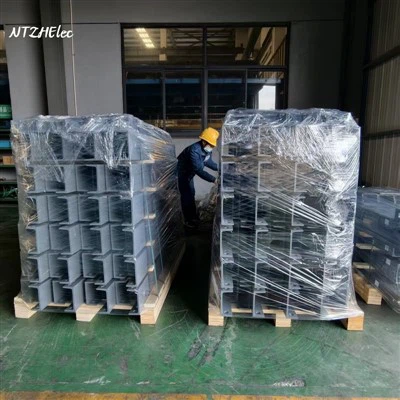
Plastic covers on tie-rod holes, rubber guards on corners, and wood padding between metal parts.
Wooden Crating
Heavy-duty wooden boxes (fumigated per ISPM 15 standard) or steel frame skids secured with steel belts inside containers.
Container Loading
Open-top container loading for long power transformer clamps, or standard 20GP/40HQ container packing for small distribution clamp sets.
Honor Certificates


FAQ