When we talk about the overall performance of a power transformer, we often focus on the electrical core and the winding insulation. But as an engineer, you know that a transformer is also a massive thermal engine. If you cannot dissipate the heat generated during peak overloads, your insulation degrades, your efficiency drops, and your unit's service life is cut in half.
This is why transformer radiators (often referred to in workshops as trafo radiators or simply transformers radiators) are the true unsung heroes of distribution and transmission grids.
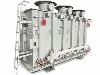
For decades, buying power transformer radiator banks meant dealing with rigid, cookie-cutter catalogs and heavy price premiums from global Tier 1 OEMs. But today, the global grid market demands agility. If you want to underbid your competitors and win high-value utility tenders, you need a custom-engineered cooling solution that offers stable cooling performance, excellent welding quality, and pressure resistance.
As a premier transformer radiator manufacturer, we understand that a trafo radiator is not just bent sheet metal-it is a critical pressure vessel that dictates the operational safety of the entire system.
Here is what it takes to build a radiator that truly delivers a long service life under the most punishing field conditions.
1. The Geometry of Heat: Optimizing Element Width and Pitch
Thermal dissipation is a precise mathematical balancing act. Whether your design requires standard 520mm width elements or compact 310mm plates, the tolerance control must be absolute.
The center-to-center distances (ranging from 500mm up to 4000mm) and the element pitch must match your transformer oil tank valves perfectly. If your vendor's tolerances are sloppy, your assembly team will waste hours on the factory floor trying to force misaligned radiator headers onto the oil tank transformer flanges. More importantly, the internal oil channels pressed into each element must be engineered to optimize oil flow velocity, ensuring efficient heat dissipation without compromising the structural pressure resistance when forced oil pumps (OFAF/ONAF) kick in.

2. Eliminating the Pinhole Threat with Leak-Free Performance
Let's talk about the absolute nightmare of any grid operator: a slow, weeping oil leak. Because trafo radiators are subjected to constant thermal cycling-expanding and contracting every single day-the weld seams endure severe mechanical fatigue.
If a factory relies on basic manual fillet welding on the radiator headers, you are looking at a disaster waiting to happen. To guarantee true leak-free performance, premium manufacturing relies on fully automated, robotic seam-welding lines. This eliminates human error, ensuring 100% penetration along the element edges.
Furthermore, to catch the sub-millimeter micro-fissures that standard air-pressure tests miss, every assembly should undergo ultraviolet fluorescent penetrant testing. If there is a hidden crack, the UV light catches it before the unit ever leaves the shop floor.
3. Beating Corrosion in the Dead Zones
The 45mm gaps between radiator elements are notorious moisture and salt traps. If a transformer is deployed in a high-humidity tropical zone, a coastal region, or a heavily polluted industrial site, ordinary spray paint will fail within a few seasons.
To achieve maximum corrosion protection, the surface treatment must be aggressive. The raw steel assembly must undergo automated shot-blasting to an Sa 2.5 cleanliness rating to strip away mill scale. Following this, the coating must be applied via automated flow-coating or electrostatic lines to push high-solid zinc primers and epoxy layers deep into the tightest fin recesses, meeting strict C4 to C5-M marine-grade specifications. For the absolute harshest environments, total hot-dip galvanizing per ISO 1461 provides an unbroken zinc barrier that stops rust in its tracks.
Co-Engineer Your Next Cooling System with Us
Stop settling for rigid, over-priced catalogs that force you to compromise your transformer design. You deserve a radiator partner that treats sheet metal fabrication with the precision of CNC machining.
Whether you are looking to optimize an existing power transformer radiator setup, matching a specific transformer oil storage layout, or designing a completely custom flange alignment, let's look at the actual engineering drawings.
Upload your radiator specifications, center distances, or header details (PDF, DWG, or STEP). Our structural engineering team will review your pressure requirements and thermal profiles, and deliver a transparent, technically sound manufacturing proposal and quote within 48 hours.
[ Submit Your Radiator Drawings · Let's Review Your Specs within 48h ]
(We protect your engineering IP fiercely. All proprietary files and technical designs are handled under strict confidentiality, and we are happy to sign a mutual NDA before you upload your data.)