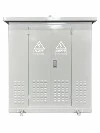
A corrugated transformer tank may fit in a residential substation and still fail to accommodate the heat loss or oil expansion requirements. For the transformer manufacturer, misalignment can create redesign or leakage investigations, or delay the housing project.
Begin with operating conditions and approved drawings, and use the same specification to judge fabrication, testing, and price.
Define Transformer Heat Losses and Residential Operating Conditions
Choose the transformer oil tank based on the losses and temperature in the transformer, the volume of oil, and the expected ambient conditions. A kVA rating defines the power handling but not the cooling requirement.
Residential load demand can change as a result of superimposed air conditioning, water pumping, and vehicle charging. Request the expected load profile, ambient temperature, altitude, and installation conditions.
For an indicative calculation, take no-load losses of 0.8 kW and rated load losses of 6.2 kW. At 80% loading, the simplified estimate would be:
Total losses = 0.8 + (0.8² × 6.2) ≈ 4.77 kW
At full load, the value would rise to 7.0 kW. This assessment keeps the loss reference temperature constant; harmonic and temperature effects require a separate assessment. www.rd.usda.gov Match Tank Dimensions to the Transformer and Substation Layout
Ensure the internal dimensions of the tank accommodate the core-and-coil assembly, insulation clearances, leads, and mounting. The external dimensions must also match the substation's installation and maintenance arrangements.
For a distribution transformer tank within a compact substation, examine the full layout with the enclosure supplier. Include projecting fins, bushings, lifting lugs, drain valves, and cable connections.
Make allowances in the tank layout for cooling passages and access. Fitting through a door is no guarantee that the fins have sufficient clearance from nearby partitions.
Note clearance requirements on the approved arrangement drawing, including future access to the transformer for removal.
Evaluate Corrugated Wall Design for Cooling and Oil Expansion
Corrugated walls increase the tank surface area available for heat transfer. In a hermetically sealed design with flexible walls, they also accommodate the volume change in the oil with temperature. www.hitachienergy.com
A corrugated transformer oil tank involves both thermal and mechanical considerations. Fin height, depth, pitch, quantity, and sheet thickness influence its behaviour.
Request the transformer designer to confirm the required cooling surface and expansion capacity. Increasing fin count without examining spacing can restrict airflow. Increasing thickness alters stiffness and can reduce movement available for oil expansion.
The finished transformer requires appropriate temperature-rise verification; fin area alone does not confirm cooling performance.
Check Steel Specifications, Wall Thickness, and Structural Strength
Call out materials, grades, and thicknesses separately for the corrugated panels, cover, bottom plate, flange, and supporting frame. These components have different roles.
Corrugated sheets must be compatible with the forming process and intended movement. The base must carry equipment weight, and the lifting attachments must withstand defined loads during handling.
Request the transformer tank manufacturer to identify material substitutions before fabrication. A steel grade is not automatically acceptable simply because its nominal thickness matches the drawing.
Confirm whether lifting points are rated for the empty tank or the assembled transformer. Specify restraints for transport that protect the fins without applying loads or deforming them.

Assess Weld Quality, Gaskets, and Sealing Details
Check the controls applied to weld fit-up, seam continuity, distortion, and repair. Examine fin seams, panel corners, attachment points, and junctions between thin corrugated sheets and heavier items.
A neat weld surface does not confirm leak tightness. Request records of inspection and traceable results for each tank.
For a bolted cover, examine flange flatness, gasket seating, bolt spacing, and the agreed procedure for tightening. Call out gasket compatibility with the insulating liquid and operating temperature.
The transformer tank should be supplied with the interior clean, welding debris removed, and openings protected. Leftover contamination requires extra work before the active part can be installed.

Select Protective Coatings for the Installation Environment
A sheltered inland housing development and a coastal community will have different corrosion requirements. Call out exposure to salt, humidity, pollution, irrigation, and standing water before choosing the coating system.
Specify surface preparation, coating products, dry film thickness, curing requirements, and repair procedures. Dry film thickness is the coating thickness after drying.
ISO 12944 separates environmental corrosivity from coating durability. Its high durability category covers 15–25 years to first major maintenance; this is a planning duration, not a product warranty. www.hempel.com
Request inspection of recesses, edges, welds, and the underside of the base. Confirm any internal coating is approved for the selected insulating liquid.
Specify Leak Testing, Pressure Testing, and Inspection Requirements
Agree on the test procedure before the order is issued. IEC 60076-1 deals with vacuum, pressure, and leak tests on transformer tanks, but the purchase specification must identify the requirements for the design. webstore.iec.ch
For flexible corrugated walls, define pressure, duration, test medium, allowed deformation, and acceptance criteria with the transformer designer. Do not copy a rigid tank's test pressure into the order.
Distinguish between leak detection and structural verification. If an approved pneumatic bubble test method is to be used, inspect the specified seams and joints, and repair and retest any leakage.
Also specify dimensional checks, records of coatings applied, and any required pressure-cycle testing. Confirm vacuum capability before specifying vacuum processing.

Compare Price per Kilogram, Supply Scope, and Production Schedules
To compare transformer tank price, multiply the quoted rate by the agreed billable weight, then add any excluded items. Confirm whether the weight is based on approved drawings or actual weighing, and what items it includes.
The following figures are illustrative, not market quotations. Both offers are for the same approved design and billable weight.
| Cost item | Supplier A | Supplier B |
|---|---|---|
| Billable weight | 380 kg | 380 kg |
| Quoted unit price | USD 3.00/kg | USD 3.20/kg |
| Base amount | USD 1,140 | USD 1,216 |
| Required coating upgrade | USD 120 | Included |
| Comparable subtotal | USD 1,260 | USD 1,216 |
Freight and taxes are excluded from this example. Supplier B's higher unit rate produces a lower subtotal when the coating scope is equal.
Confirm when production starts, allowance for inspection and curing, packing arrangements, and dispatch time. Set production time and transport time separately.
Send each bidder the same drawing revision, inspection requirements, and coating specification. Attach the agreed weight basis, excluded items, and production schedule to the purchase order.