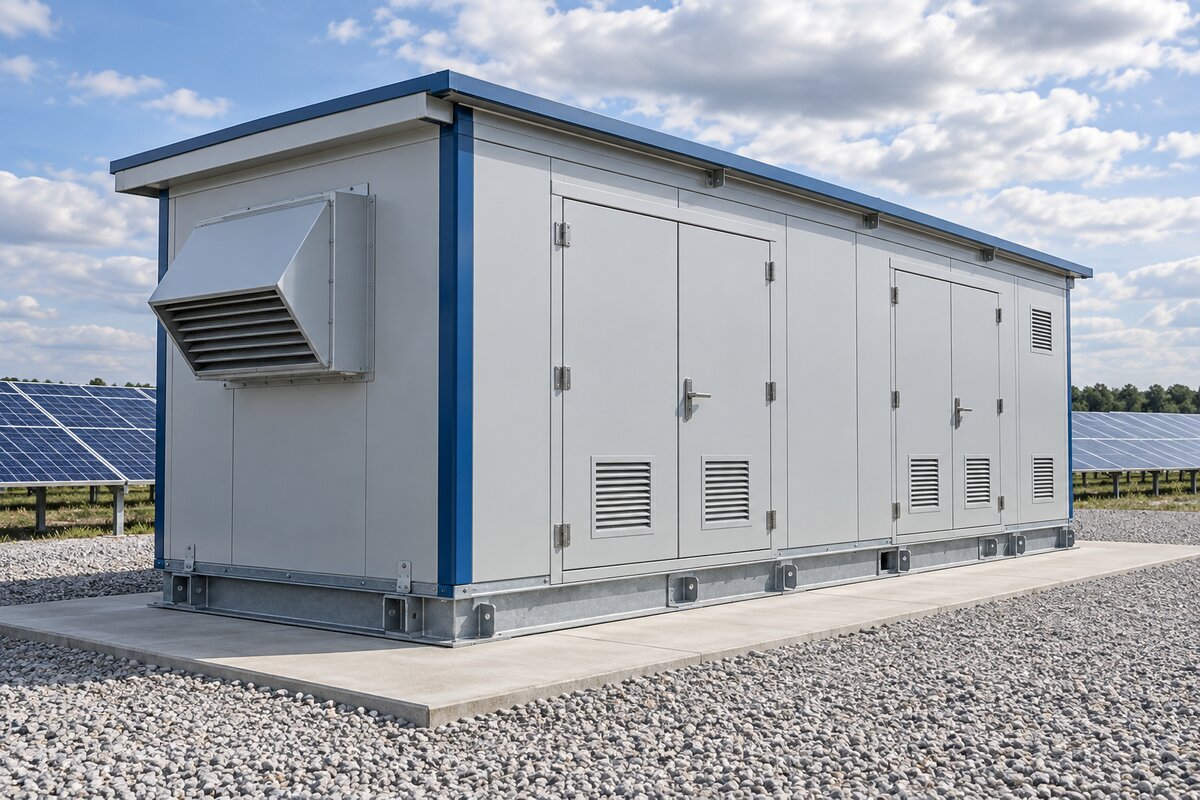
The cheapest quote for an e house enclosure may leave the owner responsible for insulation, floor reinforcement, or export packing. Discovering those exclusions after the order has gone through may delay equipment installation on a solar or wind project.
The easiest comparison puts each quotation against the same supply scope, design requirements, inspection plan, and delivery point.
Define a Common Supply Scope Prior to Price Comparison
Begin the request for proposal process with a written supply scope outline. Not all bidders propose similar supply options-an enclosure shell, fitted electrical room, or complete E-house with electrical equipment all define different supply packages.
ABB, for example, offers integrated E-house modules equipped with switchgear and automation cabinets plus environmental control systems.
Request that each electrical enclosure manufacturer indicates included, optional, or excluded supply items. This list should define the steel structure, floor, doors, insulation, fittings, ventilation equipment, lighting, and earthing provisions.
Determine responsibility for supplying and installing each electrical cabinet. Clarify whether mounting rails and accessories are included in the enclosure cost.
Request the Same Drawings, Dimensions and Equipment Interfaces
Distribute the same revision of power or automation drawings and equipment layout to each bidder on the shortlist. Different assumptions about equipment interfaces will create price discrepancies even when the overall enclosure dimensions appear identical.
Compare quotes based on usable room after insulation and lining installation, including cabinet footprints, clearance aisle widths, door swing radius, cable bending radius, and equipment replacement access.
On a solar project, clarify switchgear or inverter equipment interfaces if applicable. On a wind farm, coordinate cable entry and protection equipment clearances with the electrical integrator.
Clarify responsibility for cutouts and mounting holes, particularly where field modifications would require coating repairs and revised sealing provisions.
Specify whether external stairs, access platforms, removable roof sections, and inter-module connections are included in the quotation.
Evaluate Steel Grades, Structural Design, and Fabrication Requirements
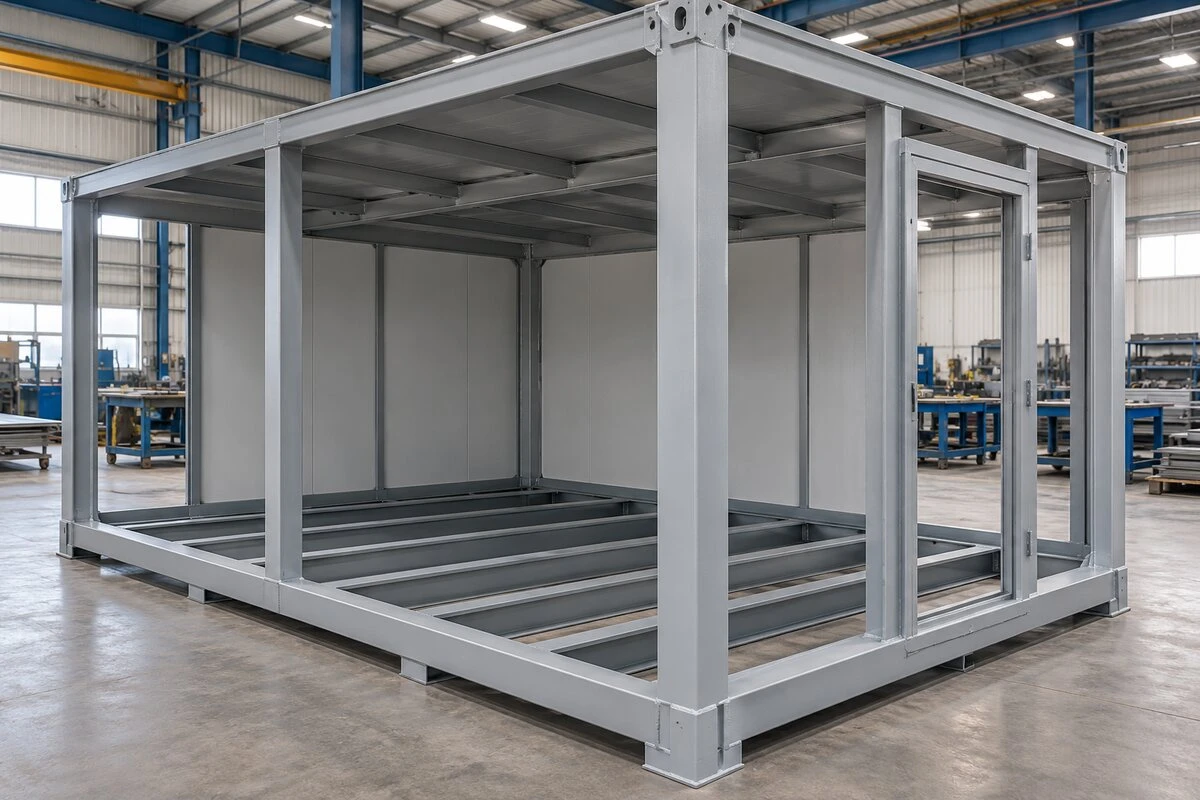
Wall panel thickness affects panel strength, but overall enclosure strength depends on other structural elements. Compare steel grades and sections specified for the frame, floor supports, roof construction, lifting points, and welding requirements.
A theoretical example illustrates the importance of checking floor loading:
| Parameter | Illustrative Value |
|---|---|
| Electrical cabinet mass | 1,800 kg |
| Cabinet footprint | 2 m² |
| Gravitational acceleration | 9.81 m/s² |
| Cabinet weight | Approximately 17.7 kN |
| Average load over the footprint | Approximately 8.8 kN/m² |
Average load = 1,800 × 9.81 ÷ 2 ÷ 1,000 ≈ 8.8 kN/m²
This average does not account for concentrated loads from the cabinet feet. A uniformly distributed floor load rating alone cannot verify compatibility with the supporting structure.
Request a calculation note that specifies design wind and snow loads at the project location and the conditions of transport and lifting. Confirm whether the calculation applies to an empty shell or an enclosure with electrical equipment installed.
Clarify who bears responsibility for design approval before fabrication.
Compare Ventilation, Insulation and Weatherproofing Requirements
A coastal wind farm and an inland solar farm with seasonal dust accumulation expose an electrical enclosure to different conditions. Share the ambient temperature, humidity, dust exposure, and equipment heat loss specifications with each bidder.
Clarify whether ventilation, air conditioning, and cooling equipment costs are included in the quotation.
Separate the costs of air conditioners, fans, filters, and controls from the costs of louvers, mounting brackets, and openings in the enclosure walls. A general "air conditioning ready" statement requires clarification.
Evaluate insulation based on heat transfer performance and fire requirements as well as thickness. Thermal performance describes the ability of the complete wall or roof construction to resist heat flow.
Separately, verify that the specification covers roof drainage, door seals, cable penetrations, and access for cleaning air filters.
Define the required degree of protection together with evidence for the completed arrangement. Ingress protection depends on the final doors, louvers, and other openings in the enclosure shell.
Clarify Surface Preparation and Anti-Corrosion Coating Requirements
The coating reference "C5" is too brief for a purchasing specification. Obtain the surface preparation standard, coating products, number of coats, dry film thickness, and repair procedure from the supplier.
ISO 12944 uses environmental corrosivity and coating durability as separate selection criteria. Hempel's guideline identifies 15–25 years as the high durability range for planning the time before major maintenance. This is not a warranty period.
Identify coating requirements for welds, edges, hidden joints, and the underside of the base on coastal projects.
Obtain procedures for measuring coating thickness and retaining inspection records. Similar colour selections on different quotations may conceal variations in surface preparation and coating systems.
 Discuss the Enclosure Inspection Plan, Testing, and Acceptance Procedures
Replace a general statement such as "quality checked before shipment" with an inspection plan that defines dimensional checks, weld inspections, door operation, gasket seating, coating thickness measurements, and specified water ingress tests.
Differentiate between technical documentation supporting the enclosure design and inspections performed on the ordered item. A test report for a different configuration may not cover differences in doors, roof vents, or cable openings.
Define witness points, notice periods, and documentation required for inspection and release. Establish financial responsibilities if retesting is required after a failed inspection.
The acceptance procedures for an e house enclosure should verify the agreed mechanical supply package. Electrical functionality tests require a separate agreement if equipment integration belongs to another contractor.
Compare Production Timelines, Packing and Delivery Conditions
Clarify what triggers the start of the production clock: receipt of the purchase order, an agreed deposit, approved drawings, or material confirmation.
Compare the quoted milestones for drawing approval, fabrication, coating completion, inspection, and factory dispatch.
Request a specific packing description. Define protection requirements for enclosure doors, openings, lifting points, and other vulnerable fittings.
Verify shipping dimensions, weight, and transport arrangements before agreeing on logistics, especially when the quotation specifies delivery to a remote wind farm.
Use the agreed Incoterms® 2020 rule and named place or port. Clarify freight, insurance, unloading, customs, and inland delivery responsibilities. The selected rule allocates specified costs and risks between the parties.
Separate the factory completion date from the arrival date on site. Allow sufficient time for receiving inspection and assembly if the bidders propose separate module shipments.
Compare Prices per Kilogram, Billable Weight, and Commercial Terms
For sheet metal enclosure quotations priced by weight, start with two figures: the price per kilogram and the agreed billable weight. A lower kilogram rate does not necessarily produce a lower total purchase cost.
Ask each electrical enclosure manufacturer whether the quotation uses theoretical weight calculated from approved drawings or actual measured weight. Confirm which components are counted, including the frame, wall panels, roof, floor, and doors. Keep packaging weight separate unless the contract explicitly includes it in the pricing basis.
Base quoted amount = Price per kilogram × Agreed billable weight
The following assumed figures illustrate the comparison. They are not market prices.
| Quotation Item | Supplier A | Supplier B |
|---|---|---|
| Quoted unit price | $4.20/kg | $4.70/kg |
| Assumed billable steel weight | 10,000 kg | 10,000 kg |
| Base quoted amount | $42,000 | $47,000 |
| Required coating upgrade | $3,000 | Included |
| Required floor insulation | $4,000 | Included |
| Export packing | $2,000 | Included |
| Comparable total before freight and taxes | $51,000 | $47,000 |
| Total divided by the agreed steel weight | $5.10/kg | $4.70/kg |
Supplier A initially quotes $0.50/kg less, but its total becomes $4,000 higher after the required additions.
Before comparing rates, check that both offers follow the same steel grades, plate thicknesses, reinforcement details, welding requirements, and coating specifications. If quoted weights differ, ask suppliers to explain the difference against the drawings.
An online search for "electrical enclousre price" cannot establish these project-specific costs. Obtain a written breakdown, then confirm quotation validity, payment milestones, warranty coverage, and delivery terms.
Attach the agreed unit rate, weight calculation or weighing method, and included processes to the purchase order.
Frequently Asked Questions
Does a lower price per kilogram mean a cheaper electrical enclosure?
Not necessarily. A lower rate may exclude coating, reinforcement, inspection, or packing. Compare the total cost for the same approved design, material specifications, and delivery basis. If suppliers quote different weights, request an explanation against the drawings.
Which weight should be used to compare enclosure quotations?
Use the weight basis agreed in the purchase specification. Confirm whether it is theoretical weight calculated from approved drawings or actual measured weight, and which components are included. Identify product net weight and shipping gross weight separately.
Does the quoted kilogram price include welding, coating, and packing?
Only when the quotation states that these items are included. Ask the supplier to identify cutting, forming, welding, surface preparation, coating, inspection, and packing costs. Obtain separate prices for exclusions before comparing the offers.
Does an E-house enclosure quotation include electrical cabinets?
An enclosure-only quotation does not automatically include switchgear, a populated electrical cabinet, control wiring, or commissioning. ZHIHE supplies the fabricated enclosure and agreed sheet metal structures. Electrical equipment supply and system integration must be allocated separately.
What information does an electrical enclosure manufacturer need for a quotation?
Provide general arrangement and fabrication drawings, material grades, plate thicknesses, equipment layouts and loads, coating requirements, and quantities. Include inspection requirements, packing expectations, delivery destination, and the required schedule. Agree the weight basis before confirming the order.
Does enclosure production time include shipping?
Production time and transport time should be quoted separately. Confirm what starts the production schedule and whether it includes drawing approval, coating curing, inspection, and packing. Request separate dates for factory completion, dispatch, and expected arrival.