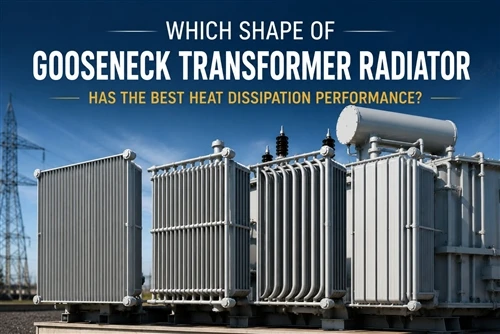
As a leading supplier of Gooseneck Transformer Radiator, I've witnessed firsthand the critical role that heat dissipation plays in the performance and longevity of transformers. One of the most frequently asked questions in the industry is, "Which shape of gooseneck transformer radiator has the best heat dissipation performance?" In this blog post, I'll delve into the science behind heat transfer and explore the different shapes of gooseneck transformer radiators to determine which one offers the most efficient cooling.
Understanding Heat Transfer in Transformer Radiators
Before we dive into the specifics of radiator shapes, it's essential to understand the principles of heat transfer. Transformers generate heat during operation, and if this heat is not effectively dissipated, it can lead to overheating, reduced efficiency, and even premature failure. There are three primary modes of heat transfer: conduction, convection, and radiation.
- Conduction: This is the transfer of heat through a solid material. In the context of a transformer radiator, conduction occurs when heat is transferred from the transformer coils to the radiator fins.
- Convection: Convection involves the transfer of heat through the movement of a fluid (either liquid or gas). In a transformer radiator, natural convection occurs when the warm air around the radiator rises, creating a flow of cooler air to replace it.
- Radiation: Radiation is the transfer of heat through electromagnetic waves. While radiation plays a relatively minor role in transformer heat dissipation compared to conduction and convection, it still contributes to the overall cooling process.
The efficiency of a transformer radiator depends on its ability to facilitate these modes of heat transfer. The shape of the radiator can significantly impact its heat dissipation performance by influencing the surface area available for heat transfer, the flow of air around the radiator, and the rate of heat conduction.
Common Shapes of Gooseneck Transformer Radiators
Gooseneck transformer radiators come in various shapes, each with its own advantages and disadvantages. Here are some of the most common shapes and their characteristics:
1. Flat Panel Radiators
Flat panel radiators are one of the simplest and most common designs. They consist of a series of flat metal panels that are closely spaced and connected to the transformer. The flat surface provides a large area for heat conduction, and the gaps between the panels allow for natural convection to occur.
- Advantages:
- Simple design, easy to manufacture and install.
- Large surface area for heat transfer, which can result in efficient cooling.
- Low cost compared to more complex radiator designs.
- Disadvantages:
- Limited air flow between the panels, which can reduce the effectiveness of convection.
- Susceptible to dust and debris accumulation, which can impede heat transfer.
2. Fin-and-Tube Radiators
Fin-and-tube radiators feature a series of tubes that carry the transformer oil or coolant, surrounded by fins that increase the surface area for heat transfer. The fins are typically made of aluminum or copper, which are excellent conductors of heat.
- Advantages:
- High heat transfer efficiency due to the large surface area provided by the fins.
- Good air flow characteristics, which enhance convection.
- Can be customized to suit different transformer sizes and cooling requirements.
- Disadvantages:
- More complex design and higher manufacturing cost compared to flat panel radiators.
- Prone to damage if the fins are bent or deformed.
3. Spiral Radiators
Spiral radiators have a unique design in which the radiator fins are arranged in a spiral pattern around a central tube. This design promotes a more uniform flow of air around the radiator, which can improve heat dissipation.


- Advantages:
- Excellent air flow characteristics, resulting in efficient convection.
- Compact design, which can save space in transformer installations.
- Reduced susceptibility to dust and debris accumulation compared to flat panel radiators.
- Disadvantages:
- More difficult to manufacture and install compared to other radiator shapes.
- Higher cost due to the complexity of the design.
Comparing the Heat Dissipation Performance of Different Shapes
To determine which shape of gooseneck transformer radiator has the best heat dissipation performance, several factors need to be considered, including the surface area available for heat transfer, the air flow characteristics, and the thermal conductivity of the materials used.
Surface Area
The larger the surface area of the radiator, the more heat can be transferred from the transformer to the surrounding environment. In this regard, fin-and-tube radiators have an advantage over flat panel radiators and spiral radiators, as the fins significantly increase the surface area available for heat transfer.
Air Flow
Good air flow is essential for efficient convection, which is a major factor in transformer heat dissipation. Spiral radiators are designed to promote a more uniform flow of air around the radiator, which can result in better convection compared to flat panel radiators. Fin-and-tube radiators also offer good air flow characteristics, especially if the fins are properly spaced.
Thermal Conductivity
The thermal conductivity of the materials used in the radiator can also affect its heat dissipation performance. Aluminum and copper are commonly used in radiator construction due to their high thermal conductivity. These materials allow heat to be conducted quickly from the transformer to the radiator fins, where it can be dissipated into the surrounding environment.
Conclusion
In conclusion, the shape of a gooseneck transformer radiator can have a significant impact on its heat dissipation performance. While each shape has its own advantages and disadvantages, fin-and-tube radiators generally offer the best combination of high surface area, good air flow, and efficient heat conduction. However, the specific requirements of the transformer installation, such as available space, cost, and cooling capacity, will ultimately determine the most suitable radiator shape.
As a supplier of Gooseneck Transformer Radiator, I'm committed to providing high-quality radiators that meet the diverse needs of our customers. If you're in the market for a transformer radiator or have questions about heat dissipation performance, I encourage you to contact us to discuss your requirements. Our team of experts will be happy to assist you in selecting the right radiator shape and design for your application.
References
- Incropera, F. P., & DeWitt, D. P. (2002). Fundamentals of Heat and Mass Transfer. John Wiley & Sons.
- Holman, J. P. (2002). Heat Transfer. McGraw-Hill.
- Schmidt, E. (1969). Heat Transfer. Springer.