When you're designing or procuring for power transformers, the active components-core steel, copper windings, tap changers-usually hog the spotlight during engineering reviews. But out on the grid, a transformer is fundamentally a massive thermal engine. Its continuous power rating and overload capacity live and die by its external cooling loop: the radiator banks.
Let's be direct. A radiator looks like simple bent sheet metal, but it operates as a high-stress pressure vessel constantly breathing hot oil under fluctuating grid loads. Choosing the wrong supplier doesn't just risk a delivery delay; it risks weeping oil leaks on a client site, premature corrosion in tight fin gaps, and field failures that destroy brand reputations.
If you're auditing a custom radiator manufacturer to step away from the rigid lead times and heavy premiums of legacy Tier-1 OEMs, here are the 7 granular, engineering-level checks you need to make before signing off on a contract.
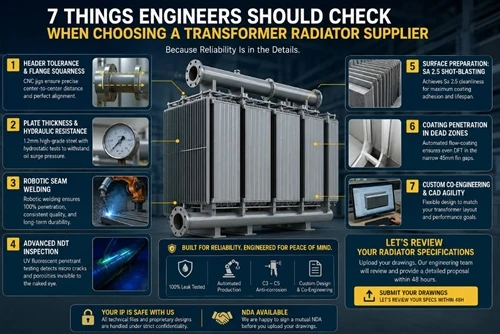
1. Header Center-to-Center Tolerance and Flange Squareness
There is nothing worse than watching an assembly crew on your factory floor try to force a 3000mm-wide radiator bank onto a transformer oil tank valve, only to find the header flange center distance is off by 3 millimeters.
When radiator elements are welded onto main header pipes, localized heat causes the metal to pull and warp. If the fabricator relies on visual alignment or basic manual jigs, those tolerances drift.
What to check: Audit their assembly fixtures. A reliable vendor must use rigid, CNC-machined welding jigs that lock the header pipes and mounting flanges into zero-tolerance positions throughout the welding and cooling cycles. Forced assembly on your floor introduces permanent mechanical tension on the tank valves before the transformer is even energized.
2. Plate Thickness and Hydraulic Surge Resistance
Whether your design specifies 520mm width elements or compact 310mm plates, the steel thickness must be precisely controlled-typically at 1.2mm high-grade cold-rolled stock.
When forced oil pumps (OFAF or ODAF) kick in during peak load spikes, a sudden hydraulic shockwave surges into the radiator headers. Go too thin on the steel, or use a vendor buying cheap, inconsistent coil stock, and the radiator elements will balloon or deform under pump pressure.
What to check: Verify their hydrostatic test reports. Ask if their pressed internal oil channels undergo physical pressure-deflection testing (typically 0.5 to 1.0 bar) to ensure maximum thermal flow velocity without structural deformation.
3. Robotic Seam Welding vs. Manual Torch Variance
Because trafo radiators endure daily thermal expansion and contraction, their weld seams suffer relentless mechanical fatigue. Manual torch welding on element edges or header roots introduces human error, inconsistent heat input, and slag inclusions that look solid on the surface but are hollow underneath.
What to check: Inspect their welding automation. A top-tier transformer radiator manufacturer should run fully automated, robotic seam-welding lines along the fin edges. Automation maintains perfectly uniform travel speeds and weld pool chemistry, achieving 100% root penetration and a smooth, uniform surface that eliminates stress concentrators and micro-fissures.
4. NDT Quality Control: Do They Use UV Fluorescent Penetrant Testing?
Standard air-pressure drop tests (submerging the unit in water and looking for bubbles) are fine for catching massive blowholes. But they routinely miss sub-millimeter micro-porosities-the microscopic cracks that synthetic transformer oil loves to exploit after 18 months of vibration and thermal cycling.
What to check: Ask if their Nondestructive Testing (NDT) protocol includes ultraviolet fluorescent penetrant testing on all header joints and fin roots. By applying a specialized dye and hitting the welds with UV light, hidden micro-fissures glow instantly before the unit ever sees a drop of zinc primer.
5. Surface Preparation: Automated Sa 2.5 Shot-Blasting
Paint doesn't stick to mill scale or microscopic oil films. If a fabricator simply wipes down raw steel or uses light chemical washing before spraying paint, the coating will begin flaking off within two seasons in the field.
What to check: Confirm that every raw radiator assembly undergoes automated shot-blasting to an Sa 2.5 cleanliness rating (ISO 8501-1). This strips away every trace of scale and creates an ideal anchor profile for multi-layer paint systems or hot-dip galvanizing.
6. Paint Penetration in the "Dead Zones" (The 45mm Fin Gap)
The 45mm gaps between radiator elements are notorious moisture traps. In high-humidity tropical zones, coastal substations, or polluted industrial corridors, standard hand-held spray guns cannot reach deep into the narrow recesses between middle elements.
What to check: Audit their coating application methodology. To hit strict C4 to C5-M marine-grade corrosion protection, the supplier must utilize automated flow-coating or electrostatic dip systems. This forces high-solid zinc primers and epoxy layers deep into the tightest fin channels, ensuring an even Dry Film Thickness (DFT) across all surfaces. For extreme environments, verify their capacity for hot-dip galvanizing per ISO 1461.
7. Custom Co-Engineering and CAD Agility
In today's market, grid projects rarely fit neatly into cookie-cutter catalog specs. Whether your footprint requires non-standard center distances (from 500mm up to 4000mm+), custom flange hole orientations, or specific element pitches to optimize natural convection (ONAN) versus forced air (ONAF), you shouldn't be locked into rigid supplier templates.
What to check: Test their engineering interface during the RFQ stage. Can their design team take your 3D CAD files (STEP, DWG, PDF), calculate heat dissipation profiles, and adapt the header interface directly to your oil tank transformer layout without massive engineering fees or months of delay?
Let's Review Your Radiator Specifications
At the end of the day, a transformer radiator shouldn't be an afterthought or a procurement headache. It should be a precision-engineered cooling vessel that lets you ship your transformers with complete confidence.
If you have a project on your desk right now-whether it's a standard distribution unit or a high-voltage power transformer line-let's skip the generic sales pitches and look at the actual math.
Upload your radiator specifications, center distances, or header flange drawings (PDF, DWG, or STEP). Our structural engineering team will review your pressure requirements, calculate thermal dissipation profiles, and send you a transparent, technically detailed fabrication proposal within 48 hours.
[ Submit Your Radiator Drawings · Let's Review Your Specs within 48h ]
(We protect your engineering IP fiercely. All technical files and proprietary designs are handled under strict confidentiality, and we are always happy to sign a mutual NDA before you upload your drawings.)