

Rural distribution networks must deliver reliable electricity across long distances while serving relatively small and widely separated loads. Building a ground-level substation for every farm, village or remote community would be expensive and difficult to maintain. For this reason, utilities commonly use single-phase pole-mounted transformers to step medium-voltage electricity down to a usable service voltage close to the customer.
The single-phase pole-mounted transformer oil tank is central to this arrangement. It contains the transformer oil, protects the active components and transfers heat to the surrounding air. Although its structure appears simple, the tank must perform reliably through changing loads, severe weather and long maintenance intervals.
1. Meeting the Power Needs of Remote Rural Communities
A pole-mounted distribution transformer provides a practical connection point between a rural medium-voltage feeder and local residential, agricultural or commercial loads. Common single-phase ratings include 10, 15, 25, 37.5, 50, 75, 100 and 167 kVA, although the actual range varies by country and utility standard.
This flexibility allows network planners to select a transformer that matches the expected demand rather than installing unnecessarily large equipment. A small unit may supply several scattered homes, while a higher-capacity transformer can serve a farm, irrigation system or rural workshop.
The oil tank makes this compact arrangement possible by combining mechanical protection, electrical insulation support and heat dissipation in one pole-mounted assembly. For isolated communities, that means dependable local voltage transformation without requiring a large fenced installation.

2. Reducing Installation Costs with Compact Pole-Mounted Designs
Space and civil-engineering costs are important considerations in rural electrification. A single-phase pole-mounted transformer tank allows the complete transformer to be installed above ground on a utility pole, reducing the need for concrete foundations, dedicated equipment rooms or extensive land acquisition.
The tank must remain compact enough for safe lifting and pole mounting while providing sufficient internal clearance for the transformer core, windings, leads and insulating oil. Its lifting lugs, mounting brackets and external accessories must also align with the transformer manufacturer's assembly requirements.
Weight control is particularly important. Excess steel increases the load on poles and lifting equipment, but reducing material without proper structural verification can cause deformation. A well-designed tank balances steel thickness, reinforcing details and overall geometry according to the transformer mass and mechanical loads.
3. Protecting Transformer Oil and Internal Components
Transformer oil performs two essential functions: it insulates energized components and carries heat away from the core and windings. The oil tank for a single-phase pole-mounted transformer must keep this liquid sealed against moisture, dust and other contaminants.
Water entering the tank can reduce the oil's dielectric performance and accelerate insulation ageing. A leaking weld or poorly sealed connection can also allow oil to escape, exposing internal components and creating an environmental concern.
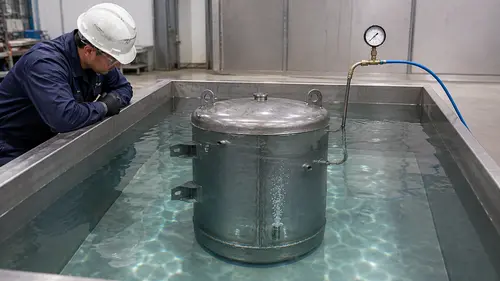
Critical areas include the tank-cover joint, bushing openings, drain connection, pressure-relief interface and welded seams. Accurate component placement and controlled welding are therefore as important as the overall tank shape. The completed tank should undergo dimensional inspection and a full leak test before surface preparation and painting.

4. Maintaining Reliable Cooling Under Variable Rural Loads
Rural transformer loading rarely remains constant. Residential demand may rise in the evening, while agricultural loads can increase sharply during irrigation, harvesting or grain-processing periods. These changing conditions produce different levels of heat inside the transformer.
In an oil-immersed unit, heat moves from the windings into the oil and then through the tank wall to the surrounding air. The external surface of a cylindrical or appropriately formed pole-mounted transformer oil tank therefore contributes directly to natural cooling.
Tank diameter, oil volume, heat-transfer area and accessory arrangement should be coordinated with the transformer's total losses. A design suitable for a 25 kVA transformer should not be copied automatically for a 100 kVA unit. The manufacturer needs the rated capacity, loss data, oil quantity and maximum ambient temperature to verify the design.
5. Withstanding Wind, Rain and Harsh Outdoor Conditions
A rural transformer may remain outdoors for decades, exposed to sunlight, rain, dust, humidity and large temperature changes. Pole-mounted equipment must also withstand wind-induced vibration and the mechanical forces created during transportation and installation.
Mounting brackets and lifting points require adequate reinforcement so that loads are transferred into the tank structure without permanent deformation. Welded joints should be positioned and finished to avoid water traps that encourage corrosion.
The coating system must match the installation environment. A standard industrial finish may be sufficient for a dry inland region, while a humid, coastal or chemically polluted area may require C4 or C5 corrosion protection. Surface preparation, primer, intermediate coat and topcoat should be specified as one compatible system rather than selected independently.
6. Preventing Oil Leakage and Reducing Maintenance Requirements
Travelling to repair a transformer in a remote location can take longer and cost more than the repair itself. A leak-resistant pole-mounted transformer tank for rural grids helps utilities reduce emergency visits and avoid unplanned outages.
Leak prevention begins with correct joint design, consistent steel preparation and stable welding parameters. It continues through the inspection of bushings, threaded fittings, cover sealing surfaces and welded accessories.
At Nantong Zhihe Electric, transformer tanks are manufactured according to customer drawings and undergo 100% leak testing. Testing is completed before the final coating process so that any defect can be repaired and retested without damaging the finished paint system. The exact test pressure and holding time should follow the customer's technical specification and applicable utility requirements.
7. Supporting Agricultural and Residential Electricity Demand
Rural electricity consumption is becoming more diverse. In addition to lighting and household appliances, distribution transformers may supply water pumps, cold-storage equipment, livestock facilities, workshops, communication systems and small renewable-energy installations.
These applications can create seasonal loads, frequent motor starts and periods of high demand. Selecting the correct rural distribution transformer oil tank therefore involves understanding how the transformer will actually operate, not merely its nameplate rating.
Utilities and transformer manufacturers should consider expected load growth, ambient temperature and maintenance access. Allowing for realistic future demand can prevent overheating and premature replacement while avoiding excessive initial investment.
8. Selecting a Reliable Pole-Mounted Transformer Oil Tank Manufacturer
A suitable supplier should be able to manufacture the tank from detailed drawings while controlling dimensions, welding, sealing and coating quality. Important information for quotation includes transformer capacity, tank dimensions, steel specification, oil volume, mounting arrangement, accessory positions, coating requirements and inspection standards.
As a China single-phase pole-mounted transformer oil tank manufacturer, Nantong Zhihe Electric supports customized production, robotic and manual welding, dimensional inspection and complete leak testing. Tanks can be manufactured for different rural-grid standards and environmental conditions.
For a new rural electrification project or replacement program, send us your drawings and technical requirements. Our engineering team can review the tank structure, manufacturing feasibility and quality-control points before production.
FAQ
1. What is a single-phase pole-mounted transformer oil tank?
A single-phase pole-mounted transformer oil tank is a welded steel enclosure that contains the transformer's core, windings and insulating oil. It protects the internal components, prevents oil leakage and transfers operating heat to the surrounding air.
2. Why are pole-mounted transformers commonly used in rural grids?
Pole-mounted transformers provide an economical way to supply small and widely separated loads. Installing the transformer on a utility pole reduces land requirements, foundation work and the need for a dedicated ground-level substation.
3. What are the common ratings of single-phase pole-mounted transformers?
Common ratings include 10, 15, 25, 37.5, 50, 75, 100 and 167 kVA. Available ratings and voltage combinations vary according to local utility standards, customer requirements and the intended rural load.
4. How does a pole-mounted transformer oil tank support cooling?
Heat moves from the transformer core and windings into the insulating oil. The heated oil transfers this energy through the steel tank wall, where it dissipates naturally into the surrounding air. Tank dimensions and heat-transfer area should be selected according to transformer losses and ambient temperature.
5. How is a pole-mounted transformer tank protected from corrosion?
The protection system normally includes steel-surface preparation, primer and a compatible topcoat. Tanks installed in humid, coastal or polluted environments may require a C4 or C5 anti-corrosion coating system based on the project specification.
6. How are transformer oil tanks checked for leakage?
The completed tank is pressurized and inspected for leakage before final painting. Welded seams, fittings, openings and sealing surfaces are checked according to the customer's test-pressure and holding-time requirements. Any defect is repaired and the tank is tested again.
7. Can pole-mounted transformer oil tanks be customized?
Yes. The tank dimensions, mounting brackets, lifting points, bushing openings, cover design, accessory positions, steel specification and coating system can be manufactured according to customer drawings and applicable utility standards.
8. What information is needed to request a quotation?
The supplier normally requires the tank drawing, transformer capacity, overall dimensions, steel specification, oil volume, mounting arrangement, accessory positions, coating requirements, order quantity and inspection standard.
Need a Reliable Tank for Your Rural Transformer Project?


